
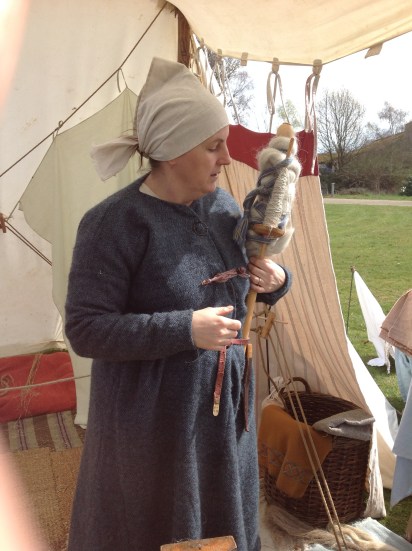
 It was lovely for us today to be the people visiting an event, rather than demonstrating at one. Today we visited ‘Craeftiga’ craft show at Sutton Hoo Anglo-Saxon burial ground. It was our first ever visit to the site. ‘Craeftiga’ is old English and means craftsman. The event is only in its second year but I hope that it will continue to grow year on year as we really enjoyed the day. We arrived as it opened at 10.30am and didn’t leave till 4.30am.
After 11 years working in the history business and 15 years in re-enactment generally, I don’t like to say ‘I’ve seen it all before’ but to a certain extent it’s true, however today we really felt like we learnt a lot. Admittedly it’s not a time period we cover but many elements of life are not dissimilar to medieval.
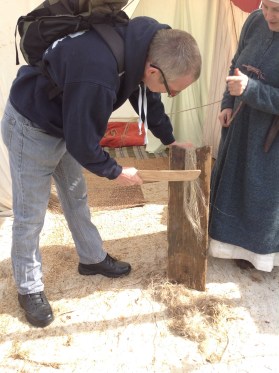 The most interesting craftsperson I think for Wel and I today was the lady demonstrating linen production from flax. I’d seen medieval pictures before of the process but it was really interesting to have somebody walk you through all the different processes. I’d never realised that there were so many different stages in the process. She explained that the flax was pulled out of the ground, to keep the strands as long as possible. The flax is then dragged through a comb to remove as many of the seed heads as possible, to use to grow next years harvest. This process is called ‘Rippling’. The flax is then ‘retted’, which is a way of rotting away the woody tissue of the plant so that the fibres in inside it can be extracted. This is done either by ‘dew retting’, which seems to be laying it out on the grass for the dew to rot it or in special ponds which I believe she set
  was called ‘water retting’. Micro organisms cause the rot. I think she said that it was similar to the organism that causes botulism. It has to be checked daily to see how rotted it is. The flax produced from dew wetting is darker in colour than water retted flax. Once this is done it is then dried. Next the flax is pulled through a ‘breaking machine’ which breaks the inner woody stalk up. Bits of the stalk are still left in the flax and these have to be removed by ‘Shiving’. A wooden Scotching knife is used to do this by dragging it down the flax. The pieces of wood fall out. The next stage is ‘Hackling’ where the flax is pulled through nailed combs. The hackle she had was very sharp indeed! Hackles could be various sizes, the first for removing the woody bits and finer toothed combs for smoothing fibres. Next she showed us how the fibres were spun into thread using a distaff and drop spindle. These were the precursor to the spinning wheel and it really showed how when the wheel came along, the great speed of it compared to the drop spindle must have seemed astonishing. In fact I was told that many medieval people feared the spinning wheel when it came, as people always fear new technologies even today! We were astonished to find out that there is a 96% wastage in producing linen like this! She said that left over bits could be used to light fires, make string or for stuffing but the fibres were shorter and not so good for spinning. I must say it was one of the best and most informative re-enactment displays I’ve seen in a very long time and a big thanks to the lady for giving so much of her time to explain it to us.
 What was really lovely about the event was that the crafts were grouped into areas together. The potters were all together, so were most of the spinning and weaving people, the calligraphers etc. As with many National Trust events it had a very relaxed, friendly and informal feel to it and we loved the fact that it was not just about purest historical craft but about the crafts that were around at the time and how they have evolved in the modern world too, making them feel like living, breathing crafts, not just ghosts from long ago.
Another craftsperson who must have special mention, is Tillerman beads. I’d seen their stand at the re-enactment markets before but if I’m honest, never really stopped to chat as it wasn’t my time period. It was nice to be free of that restriction, being just a general craft show and chat to people that I might not ordinarily do so. He asked if we’d like to see how  a bead was made and we said “We’d love to!”. It was fascinating to see how the little bead was produced and learn about the history of glass beads. He even very kindly gave Wel the glass bead he’d made and explained to us how glass itself, rather than the things made from it, is produced. He uses Murano glass as it’s the closest to the original glass that was used.
We also met a beekeeper from Honey Bee Natural Beauty who very patiently explained a lot of info to us on beekeeping (as it’s something we’d love to do). I purchased some of his beeswax which is much more natural as it has no turps in, which normal recipes do, which he explained could dry out the wood. I have just opened it to have a whiff and it smells absolutely divine. His wife next to him makes and sells natural, herbal cosmetics. The two crafts tie together quite well. I think some of the herbal remedies may find their way into birthday presents for me in a month or two as Wel went off shopping for half an hour.
 The Society of Scribes and Illuminators were there and amongst them my own calligraphy teacher Jan. They were demonstrating calligraphy and there was also a stone mason there, who specialised in letter carving. It was fascinating to see him delicately chipping away at the stone. Outside there was a pyrographer, stone mason, black smith, boat builder, jewellery maker, tapestry weaver and children were allowed to enter the sites replica of the Sutton Hoo ship called ‘Sae Wylfing’. We also got chatting to a gentleman, who was telling us about the regeneration of Woodbridge Waterfront where in the future they will be building a full size reconstruction of the ship! They hope he said to run ferries from the Wharf across to the burial site. There will also be a museum and I think he said that courses might be run there. You can read more about it here: www.woodbridgewaterfront.co.uk/
The Anglian Potters association were there, with a large tent full of many wonderful and varied potters, extremely well set out with lots of different styles of potting, all very individual. We had a lovely time chatting to them all. There were also wood turners, re-enactors and much more!
 The sites museum is brilliantly set out and explained. The centre piece of it is a recreation of what they think the burial might have looked like, it looked amazing and even had the sound effects to make you feel like you really might have been there on that night in 600 & something AD when King Raedwald was buried! There was also a chance to handle some of the extraordinary high quality replica artefacts that the museum owns. For kids there are also lovely sets of Anglo Saxons clothes and armour for them to try on. A LOT of thought has been put into the museum and I’d recommend other sites looking for a revamp to visit it and see what a great job they’ve done. Even the info boards were well thought out with large bits of text for people who just like to scan and read a little bit and more indepth text for those that like to know a little more. The detail of the craftsmanship of the items found with him were astonishing. An extremely good and modern museum but without losing the feel of the time period it’s portraying.
Thanks to all staff, re-enactors and demonstrators for making it such a great day and for letting me take their photos. We stayed for 6 hours in total.
In short I really hope that the Trust runs the event next year and I hope that you will all take time to visit it. It’s a lovely site and a great event, just don’t forget to take your woolies, it gets a tad drafty at times, especially round the burial site.
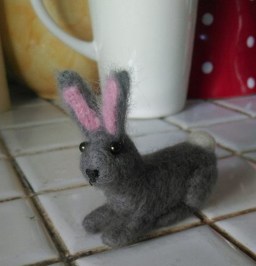 Not much historical value in this article. It’s mostly for fun. About Christmas time, chatting with my friends, I said I thought it’d be a great idea to have a craft day, where we all got together to teach each other lots of new crafty skills. This weekend it happened. We were at my friends house in Sussex and it was an amazing weekend. Very relaxing and we all came away I think feeling like we’d learnt some of the basics of a new skill.
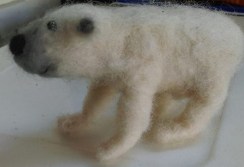
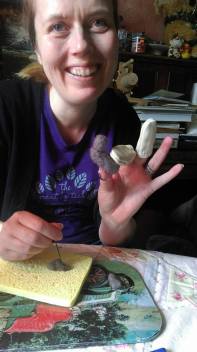 felting it with a needle into the shape of various animals. We all had basic starter kits and no experience of doing it before so my hopes weren’t especially high but we did all produce animal like creatures! With the rabbit, you make a ball for the head and a longer shape for the body. It’s simply stabbing the special needle in and out of the wool multiple times until it felts. You join the pieces together by leaving the ends looser un felted, then where you want them to join stabbing the needle through the looser pieces to join them together. It’s quite nice in that if you think it needs a bit more shape here or there, you can just felt a bit more on to it. We didn’t have glass eyes to use but we did have some beads. We did think the people visiting the church opposite must have been wondering what on earth we were doing, vigorously stabbing our needles into these tiny animals! I only drew blood once as I accidentally stabbed my finder instead of my animal!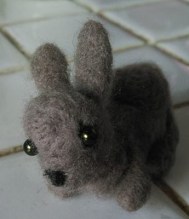
 On Saturday night, I started showing my friends some of the basics of illumination with gold leaf. I’d decided it might be fun to make our names. We traced some letters and then rubbed red bole on the back (a type of clay). We then traced over the letters again, which gave us an outline of the letters. We could have used pencil to do this but red bole is more traditional and I thought it’d be nice to try something
  different. We then all filled the inside of the first letter with gum ammoniac. Gum ammoniac is a kind of tree resin and it acts like a glue for the gold to stick to. We left our letters overnight and then this morning we gilded, painted and embellished the letters. We were using transfer gold, which is gold leaf stuck to a kind of paper. You revive GA by breathing on it, this makes it tacky enough for the gold to stick to. You quickly lay the gold over it and rub the back gently, The gold will peel away from the sheet and if you’ve applied enough GA, hopefully it will stick to the paper. You then use a really soft squirrel hair brush to remove any excess gold. Squirrel hair is used as it doesn’t scratch the gold. We
  then used gouache paint to colour the other letters and put some tracery embellishments around the letters. Finally we used some shell gold, which is powdered gold mixed with GA to add some highlights. Considering especially that it was everyones first ever attempt, I think we achieved some brilliant results and everyone seemed very pleased with their creations.


 Although this workshop was originally created for GCSE level, it seems that the way the GCSEs are taught is changing and Year 9 seems to be a more common age group for us to teach it too. We were lucky to be running the workshop in a massive hall. Usually we run the workshop in a large classroom. Although I do enjoy the more intimate feel of a classroom as I think it makes students less shy. Year 9s are a notoriously shy Year group, loathe to volunteer for any task which can make running a workshop a little challenging. As with an actor in say a panto, audience feedback and interaction really gives you something to feed on and work with and you can gage if your audience are enjoying the workshop or not. The first ever time that we ran this workshop for Year 9 or 10, we were horrified that we’d created something that they didn’t enjoy but I recall afterwards that they’d all told their teachers how much they’d loved it, much to our surprise. I think it was the same here. The students were shy to come up but we heard lots of nice comments from them on their way out.
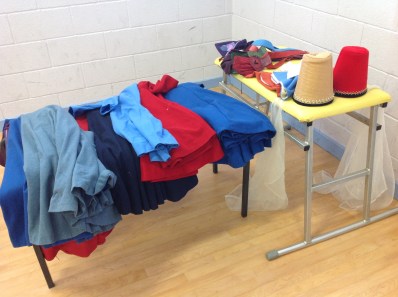
 The workshop is designed to teach the cornerstone of early medicine, the 4 humours in a fun and memorable way. To do this we bring students up to represent the humours of our medieval man and how they were related to the 4 seasons and the 4 elements. We look at how humours could be put out of balance and how an imbalance of the humours might be treated. We use some fun and memorable props to represent these things and even the teachers were wandering in at the beginning and asking why there was a firemans helmet and a Spring lamb on the table! The whole idea is present a visual, audial trigger to their memories so that when they come to their exams, they can picture their friends in their mind and how they looked and recall how all the things were linked. There were lots of photos being taken, so I’m sure they won’t forget. A big thank you to the school for letting us use some of their photos here and on our webpage.
 One of the newest parts of this workshop is the wise woman & physician debate. Wel portrays Dr William Hobbs, physician & surgeon to King Richard and his brother Edward before him. This is based on a real physician from the 15th Century, who was listed in a lovely book that I own called “Medical practitioners in Medieval England”, which lists all the known medical people from the period. Hobbs is an old family name. I picked William Hobbs in particular as he is correct for the period we portray and you never know, he may have been a relative. I portray Matilda, a fictitious wise woman from the period but the cures we talk about are based on real cures from the time. We debate whether each of us is more suitable to treat the medieval man and he must decide which of us he’d like to have treat us. Surprisingly many of the students thought that as medieval people they would chose the wise woman but I think many would have picked the physician in that day and age as he was the doctor of his day, with all the latest knowledge. Today, I agree, I’d rather put my life in the hands of the wise woman. Interestingly, I have just been reading about ‘piss merchants’ who were very much maligned by the 19th C, whereas In the 15th century, uroscopy was a science and art form. It would be interesting to run a comparative workshop to the 19th C and see how much had changed.
 We finish by looking at medieval surgery in all its gory detail! Amputations, tooth pulling, tooth worms, arrow extractions, trepanning and the wound man. Students were then allowed time at the end of the workshop to come up and view some of the replica items and ask us about them. I had some great discussions with a couple of girls, both from eastern Europe, although I’m struggling to recall which countries now. In particular about the modern use of cupping glasses. It’s always very interesting to hear such information as it enriches our own knowledge and helps us build on it. Her family were clearly strong believers in the use of dry cupping. I’m very interested in alternative medicine myself but have never tried this.
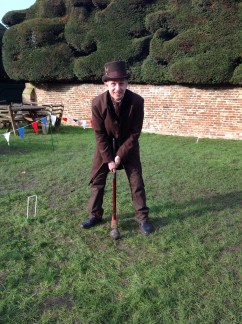 I have been very behind on the blog front lately as we’ve been so busy, so expect an onslaught of blogs this week! We were at Audley End House, Essex over half term running our Victorian toys display. We’ve been at Audley many times before, mostly in 1940s togs. This was the first time we’d been there in February. On the first day we were set up outside on the main lawn but it was extremely chilly out there and the site staff kindly offered us use of the education room with 4 lovely walls and a snug heater to keep us warm! The croquet was set up on the picnic bench lawn next to the topiary hedge & shop with various other toys around the courtyard or in the room.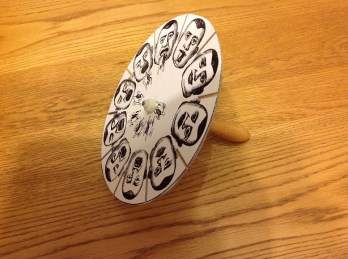
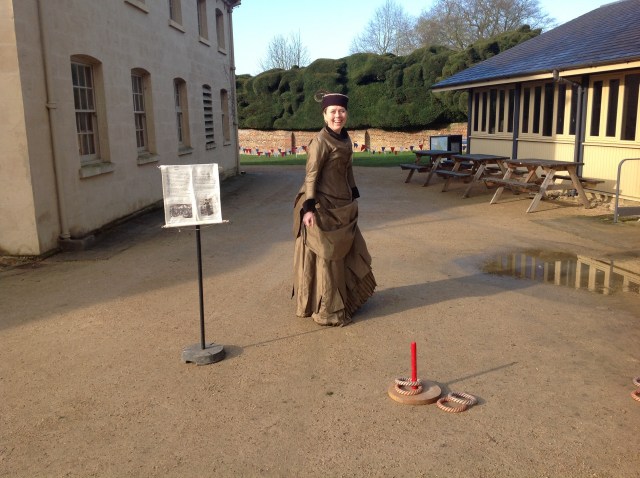 Deck quoits became a popular past time in the 19th c and would be played on board ship by passengers. It’s another huge favourite amongst families.


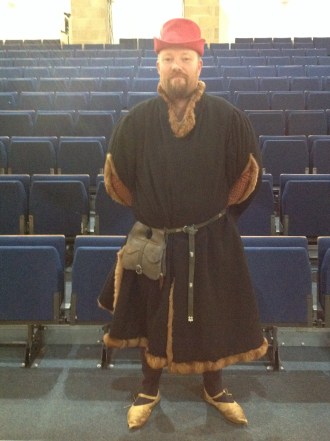
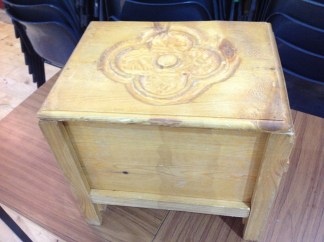 The workshop is based loosely around the Wars of the Roses with the girls were divided into 4 medieval households, the Tudors, Beautforts, Nevilles and Staffords. Each household tries to increase the power of their family by earning points, answering questions and undertaking tasks such as making their masterpieces to join a guild. We had some great potential guild members, with a perfect ten points gained for each apothecary guild member in the 1st workshop. I can’t help but think that they will all make great business women of the future. Watch out Lord Sugar!


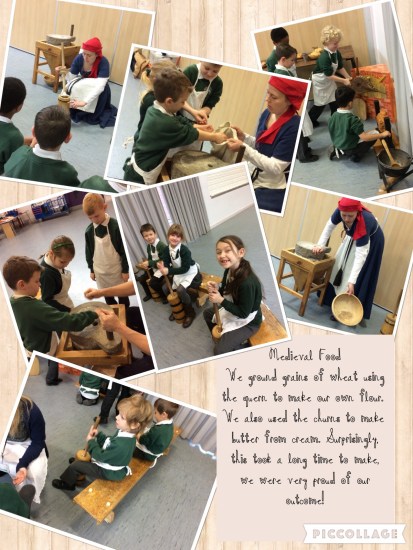
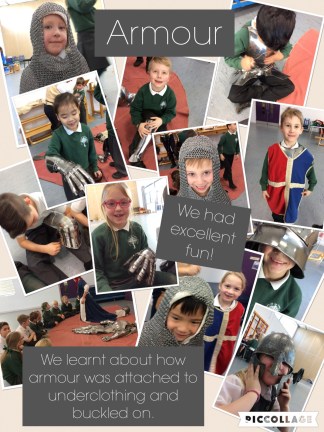
 Happening History
You must be logged in to post a comment.