
I’ve not blogged for ages, so I thought I’d start with something light and entertaining. We don’t, as amateur historians, expect everybody’s historical knowledge to match our own (sometimes it exceeds ours). Indeed, reenactors can often get historical facts wrong themselves. There’s many a half-truth travelling around that is touted as fact.
We’ve been running professional history displays for twenty years this year (2025) and over the years we’ve picked up some amusing anecdotes. Members of the public are often confused about what is and isn’t real within a historical display. It’s not surprising as fake food, for example, can often be used within displays at historic houses, but some of the comments give reenactors a good laugh as they’re sipping their mead around the campfire.
One of the commonest examples I’ve heard from other reenactors is people asking if their baby is real. People are sometimes convinced that they are carrying around some sort of animatronic baby, that cries and poops. I’m sure many reenactor parents sometimes wish that their baby came with a volume control! This applies to many other things. I have heard myself, a member of the public saying, ‘Oh, that apple looks really real, doesn’t it.’ It was real, and painstakingly researched to find the right sort of apple. Perhaps we take our realism too far sometimes. We also had a slightly scary incident where a man, holding a baby in one arm, reached through two sets of rope barriers towards our fire. Wel grabbed his arm in time and said, ‘What are you doing?’ I wanted to see if it was real, ‘he responded!’ Yes, it most certainly would have been a real burn if he’d touched it. I’ve never used a real fire in a display since.
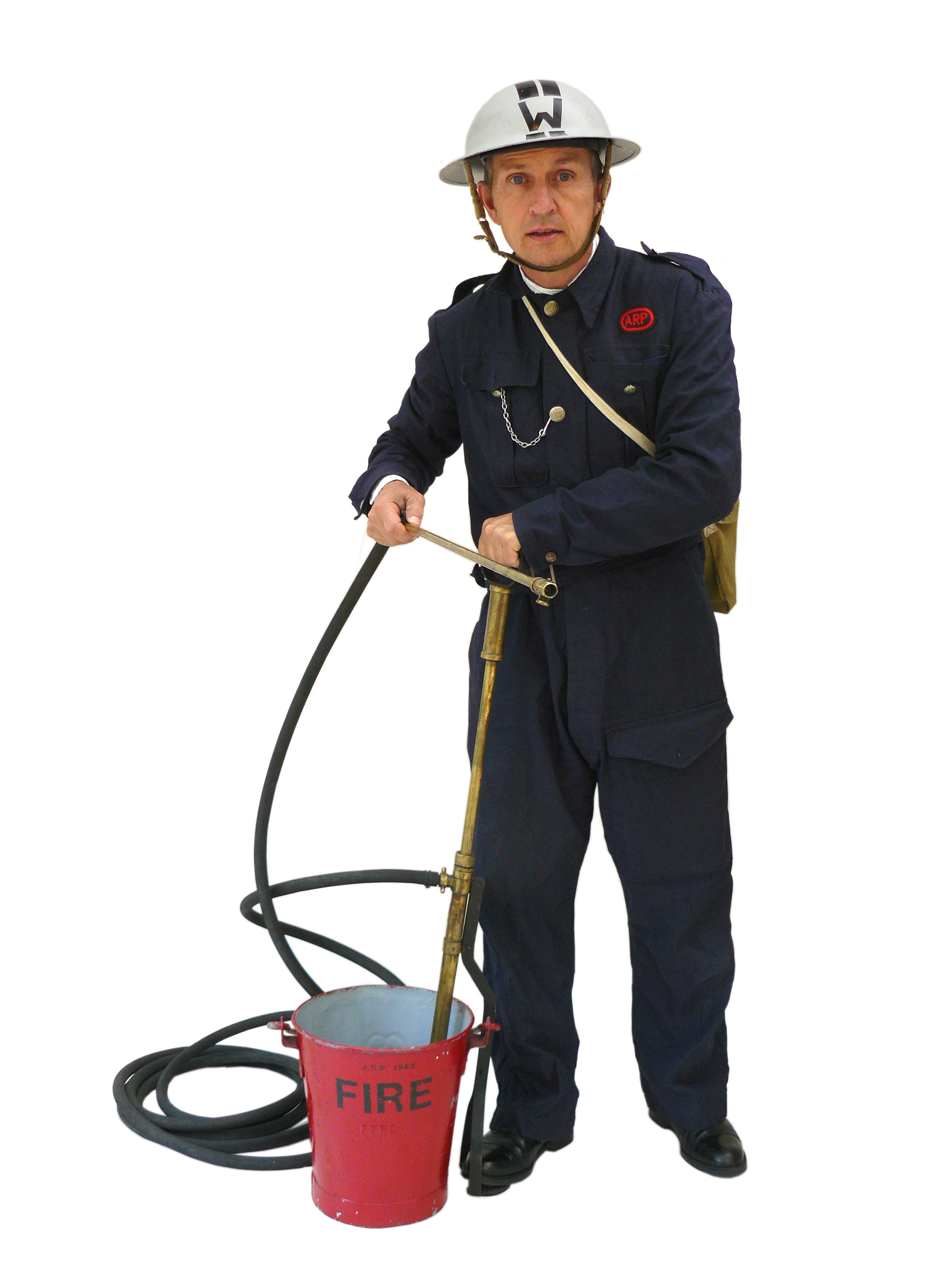
A more amusing tale was when Wel was talking to the public at an event about being a WW2 ARP warden (Air Raid). He was explaining that when incendiary bombs had time-delay explosive grenades added to the end of them, that wardens had to put the fire out by using a brick wall of a house. They would direct a hose through the window onto the fire and hide themselves behind the wall for safety. To explain this, we needed some sort of prop, as we were in the middle of a field. Wel had made a hardboard wall. It had a window, we painted bricks on it. It worked very well. At the end of one talk, a woman came up to Wel and asked, ‘I didn’t realise that they did that,’ she said. ‘Did what?’ Wel enquired. ‘Took a wall with them to put out the fires.’ A couple of other punters sniggered and walked off, Wel had to remain straight-faced and explain that it was in fact the wall of the house they were using where the fire was, rather than carrying a wall with them. We did have a chuckle later about ARP’s quickly putting up a brick wall before they put out the incendiary.
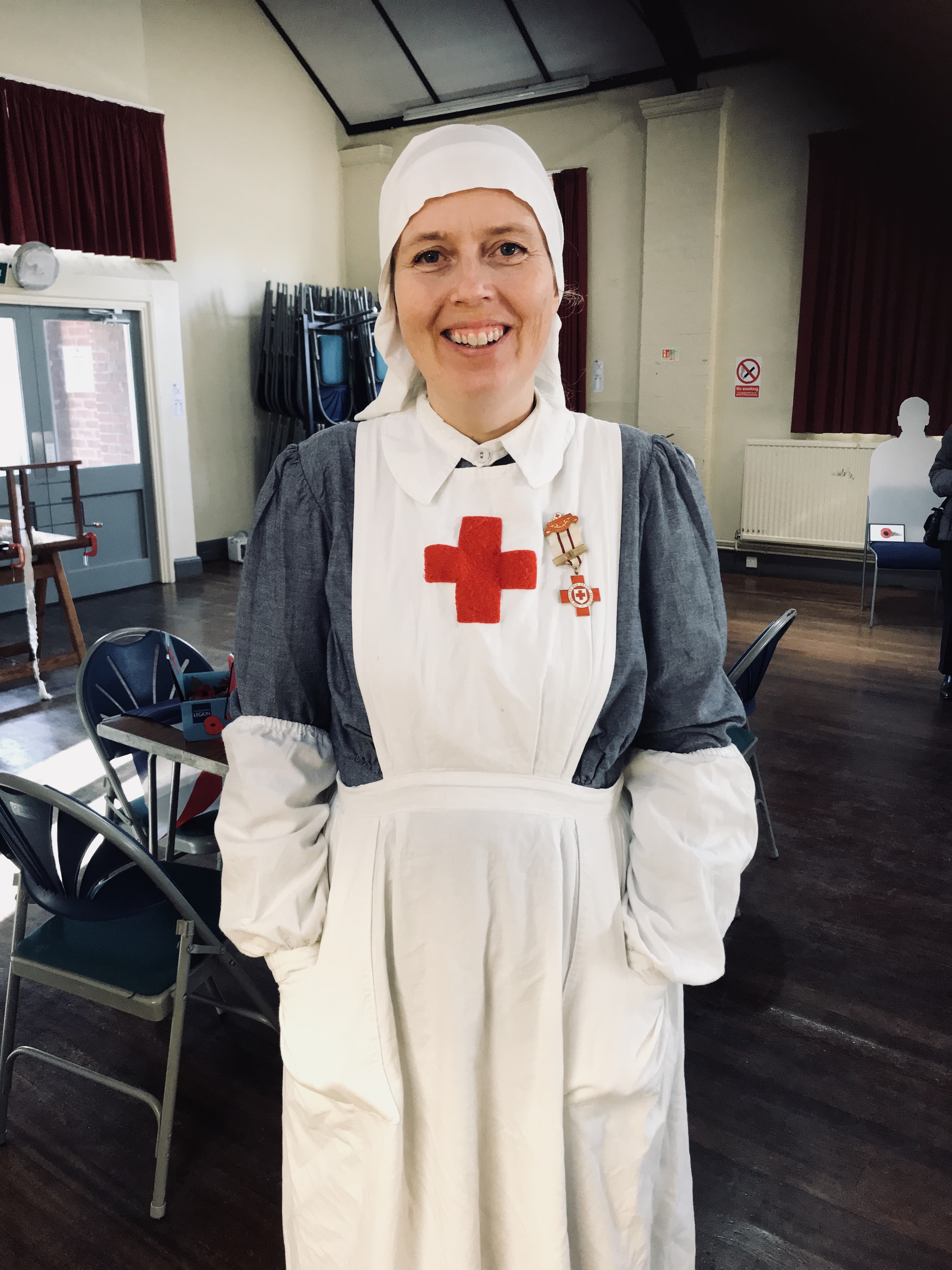
At Bodiam Castle in Kent, we were running a Penny Through Time display, showcasing pennies from the 8th century to the 20th. I was dressed as a WW1 VAD nurse. They were volunteers from the Red Cross and St John’s ambulance. You can see me dressed as one above. A man came up to me and asked, ‘Are you a medieval crusader?’ I can see where the confusion came from here. I’m at a castle, wearing a red cross on a white background, but Wel was dressed as a WW1 soldier!
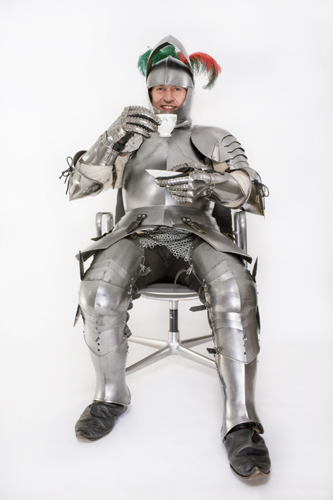
At a castle in East Anglia, we were giving talks on various subjects. There were three of us and we’d all been separated, which made break times difficult. Wel and a friend were in the basement area. They agreed to try to keep an eye on each others area during toilet breaks, but our friend got busy. When Wel went to take a break, he came back to find a mother and child behind the rope barrier, drinking from his cup of water.
‘What are you doing?’ he enquired.
‘He was thirsty,’ responded the mum.
‘But that’s my water and you don’t even know what’s in it. It could be fluid for cleaning the armour!’ said Wel in frustration, who now had no drink. The shocking bit was that there was a café in the castle, only 50 yards or so away where they could have brought a drink.
Children are so innocent and are often very entertaining to talk to. I recall this endearing tale from a decade or more ago. We were once attending a St George’s day event. We were medieval something or others, I can’t recall what now, but Wel was wearing a green hat. A small girl of about three years of age, walked up to him, tugged his trouser leg and said:
‘Excuse me, but do all elves have such big pointy noses?’
‘Yes’, said Wel.
‘Where do you live?’ she enquired.
‘In a toadstool,’ he responded.
‘You’re too big. You wouldn’t fit,’ she said with a quizzical brow.
‘I’m magical,’ he replied.
‘Oh…’ Seemingly happy with the response as making sense. ‘Can I see your pointy ears.’
‘No, the dragon might see me. Then he’d eat me.’
‘Oh, ok,’ she said knowingly, then gave him a hug and walked away, much to the parent’s delight.
Sometimes, even though we teach history, I don’t think putting a little wonder into the world of someone so tiny is a bad thing!
I love the things that children say to me sometimes. In a WW1 workshop, a fifteen year old boy asked me if the past had been in black and white and then changed to colour, which I found amusing, as I too recall wondering this as a child. Not realising that early photography was black and white. I also thought that years ago people used to spontaneously burst into song and dance. I loved watching old Gene Kelly and Fred Astaire movies.
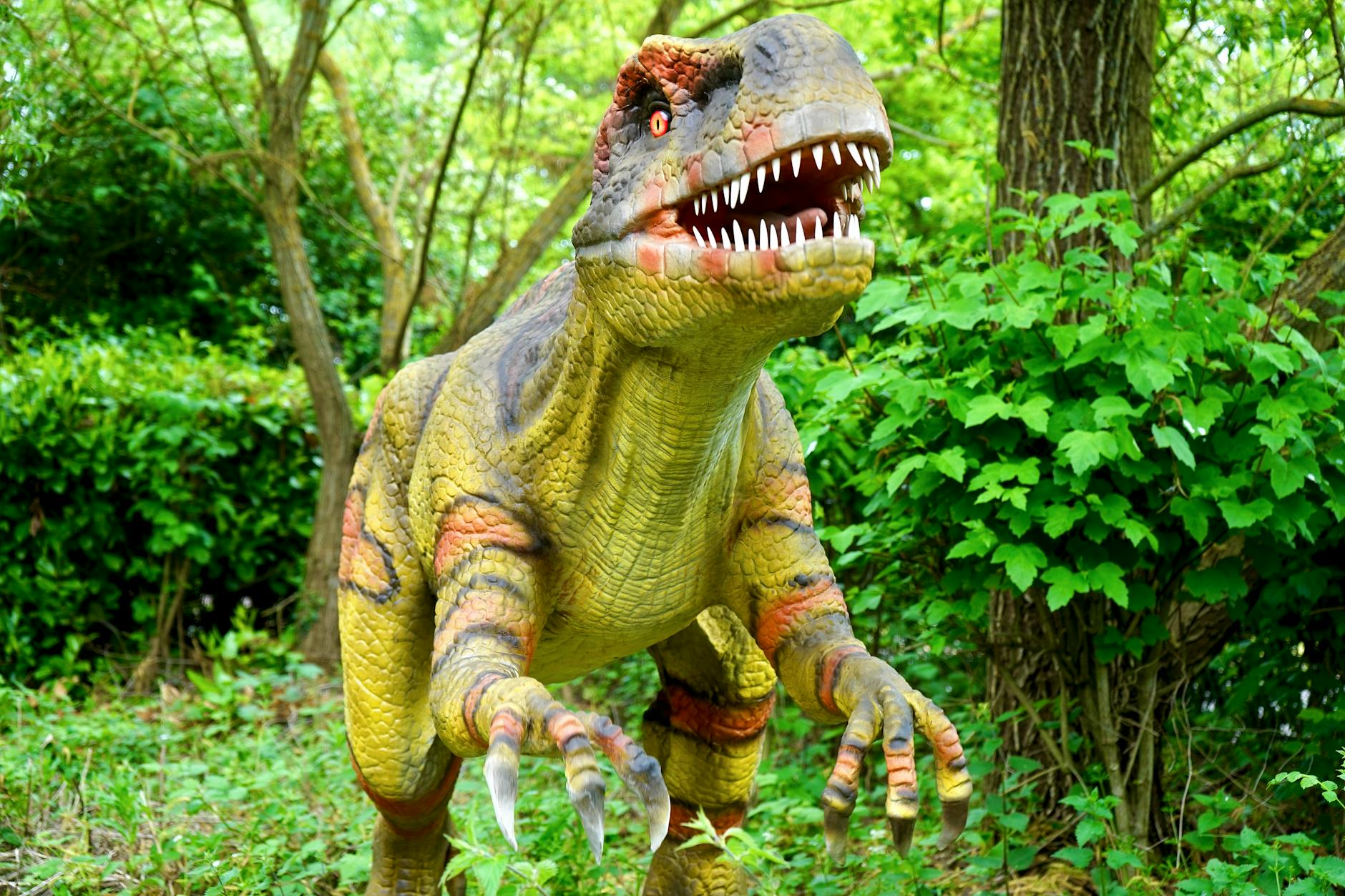
At a medieval event once, when I was talking about medieval surgery, I was asked by a boy, of about ten, ‘Why did the dinosaurs die out?’ I was surprised for a moment, but luckily, I knew a bit about this subject, so I explained to him my thoughts on the subject. Whether he believed I was old enough to remember the dinosaurs, or it was just a random question, I’ll never know!
When we run our KS1 castles workshop, the boys take off their shoes to try on the medieval trousers. This sometimes presents as a muddle when they come to putting them back on. I pointed out to one boy that he’d put his shoes on the wrong feet. ‘Oh!’ he said and crossed his legs. Shoes in the right order! Perfect child logic.
In the same workshop, we have a kitchen area, with a pretend bread oven. I ask the kids what they think might heat up our ovens. I recall one boy responding, ‘Volcanoes’. I had this wonderful image in my mind of a Fred Flintstone type oven, heated by volcano power.
A boy of about five, in our Castle Life workshop once said, ‘Where do you learn all this stuff?’. I responded with, ‘I read a lot of books.’ His jaw dropped and he said, ‘You can learn things from books?’ He was clearly impressed with this little nugget of information. I could imagine him going off and saying, ‘Right! As he raided books from the school library!
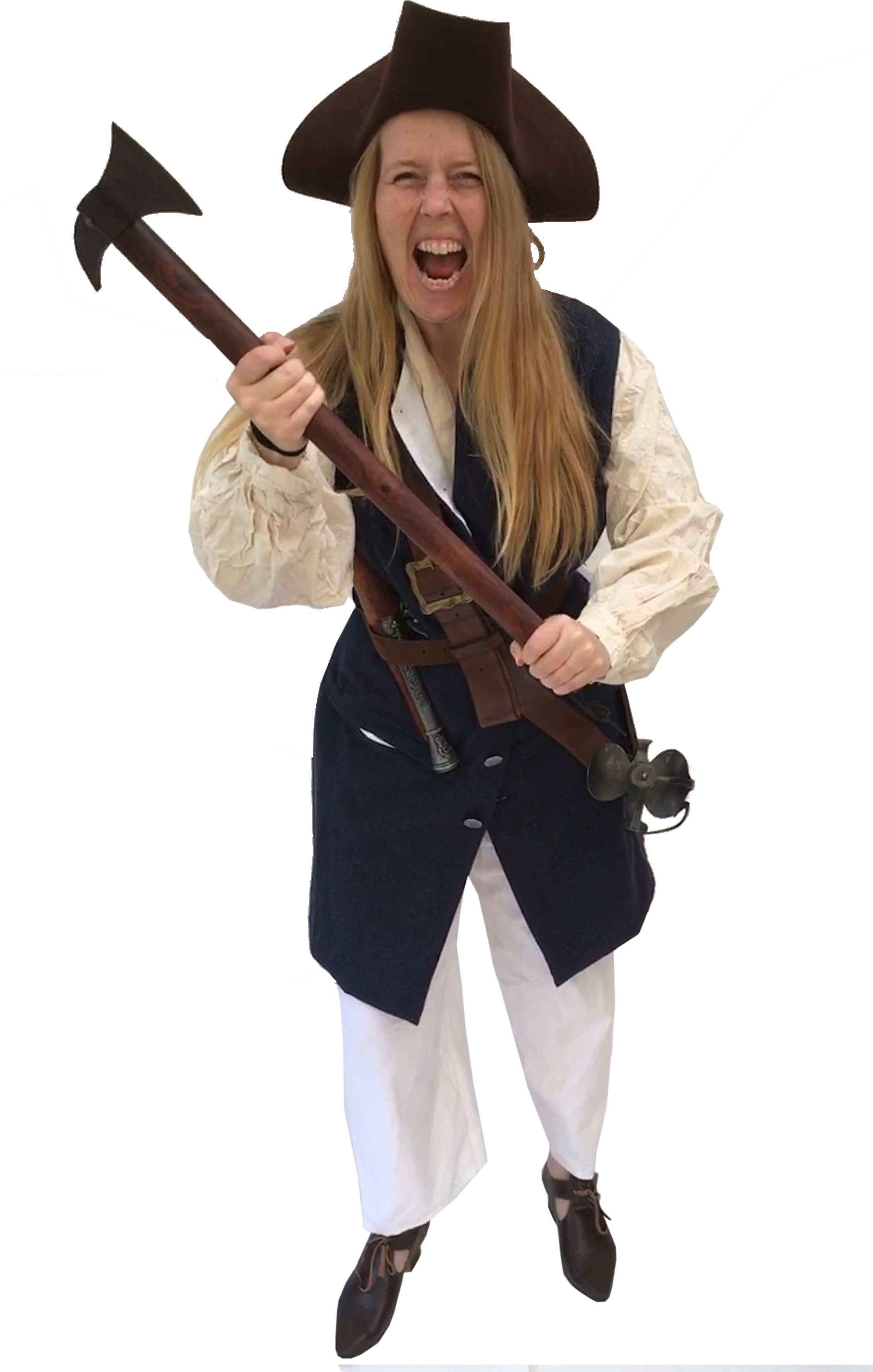
In our KS1 pirate workshop, a small boy was looking through our telescope to see the kraken monster dragging a ship down.
‘But that’s not a real Kraken! It’s only a picture of one!’ he exclaimed.
Me: ‘Well the school was a bit small to fit a real one in!’
Teacher: ‘And they’re very hard to catch!’
I DEMAND A REAL KRAKEN!
At the end of a year 7 workshop, a boy & girl asked me what my name was. I told him and they both said, ‘Oh!’ Then he said ’You’re probably the best Karen I’ve met. You’re quite nice’. ‘Oh, thanks’, I said. ‘Yes, I’ve been watching some videos of some horrible Karens. They’re always fighting and getting into trouble.’ Me: ‘?!?!!, ok, thanks?’ I think!
I hope you’ve enjoyed this anecdotes from our decades spent running workshops. I’m sure that there are many more but I didn’t want to bore you with too many. Hopefully, they’ll be many more to come.

 Happening History
You must be logged in to post a comment.